Is Plant Protein a Complete Protein? The Truth About Essential Amino Acids
If you’ve ever looked into plant protein, you’ve probably heard this sentence:
“Plant protein is incomplete.”
It gets repeated everywhere.
You hear it in gyms, nutrition conversations, supplement stores and even on social media.
But is it actually that simple?
Not really.
Some plant proteins contain lower amounts of certain essential amino acids compared with others. But that doesn’t mean your body simply looks at a plant protein and says, “Nope, this doesn’t count.”
The reality is more interesting.
Let’s break down what a complete protein actually means, which amino acids matter, why pea and rice proteins are often combined, and whether plant protein can genuinely support muscle growth.
First, What Is a Complete Protein?
Protein isn’t just one nutrient.
It’s made up of smaller building blocks called amino acids.
There are 20 amino acids commonly used by the human body to build proteins. Nine of them are considered essential amino acids (EAAs) because your body cannot make enough of them on its own.
These nine are:
- Histidine
- Isoleucine
- Leucine
- Lysine
- Methionine
- Phenylalanine
- Threonine
- Tryptophan
- Valine
You need to obtain these essential amino acids from your diet.
A complete protein is generally described as a protein source that provides all nine essential amino acids in adequate proportions.
And this is where the plant-protein discussion usually begins.
Are Plant Proteins Incomplete?
Here’s where things get unnecessarily confusing.
It’s true that many individual plant protein sources have a less favourable essential amino-acid pattern compared with high-quality animal proteins.
For example, some plant proteins can be relatively lower in lysine, while others may be relatively lower in methionine.
But saying:
“Plant protein has no essential amino acids.”
would obviously be wrong.
Plant proteins contain essential amino acids.
The question is how much of each amino acid is present relative to what the body needs.
That’s a much more accurate way of looking at protein quality.
Think of Protein Like a Team
Here’s an easy way to understand it.
Imagine your body needs nine players to start a match.
You have all nine players, but one position only has one player available while another position has five.
You technically have everyone you need, but the overall team is limited by the weakest position.
Protein quality works somewhat like this.
It’s not simply about asking:
“Does this food contain all nine essential amino acids?”
It’s also about asking:
“Does it provide them in useful amounts, and how well can the body digest and utilize the protein?”
That’s why simply calling a food “complete” or “incomplete” doesn’t tell the whole story.
What Are Essential Amino Acids?
Your body uses amino acids for much more than muscle.
They’re involved in building and maintaining proteins throughout the body.
That includes structural proteins, enzymes, transport proteins and many other proteins involved in normal physiological processes.
For people interested in fitness, however, one amino acid gets a disproportionate amount of attention:
Leucine.
And for good reason.
Why Is Leucine So Important?
Leucine is one of the three branched-chain amino acids (BCAAs), along with isoleucine and valine.
It also plays an important role in signalling pathways involved in muscle protein synthesis.
This doesn’t mean leucine is a magic muscle-building amino acid.
You still need the other essential amino acids to actually build new proteins.
Think of it like construction.
Leucine can help signal that construction should begin.
But you still need the rest of the raw materials to build the structure.
So drinking a protein source containing leucine doesn’t magically build muscle by itself.
Your overall protein intake, amino-acid availability, resistance training, energy intake, recovery and many other factors matter.
What About Lysine and Methionine?
This is where different plant proteins become interesting.
Different plants have different amino-acid profiles.
For example, legume proteins such as pea protein tend to provide relatively good amounts of lysine but can be comparatively lower in sulfur-containing amino acids such as methionine.
On the other hand, cereal proteins such as rice protein tend to have a different amino-acid profile.
This is one reason nutritionists and food formulators often look at complementary protein sources rather than treating every plant protein as identical.
And this brings us to one of the most useful combinations in plant protein:
Pea + Rice Protein
Pea protein and rice protein have different amino-acid characteristics.
Combining them can help create a more balanced overall amino-acid profile than relying on either source alone.
This is often referred to as protein complementation.
And no, you don’t have to sit down with a calculator and make sure you eat rice protein immediately after pea protein.
Your overall dietary pattern matters much more than obsessing over the exact timing of individual plant proteins.
Do You Need to Combine Plant Proteins at Every Meal?
No.
This is another old idea that gets taken too literally.
You don’t need to make every meal a perfectly calculated amino-acid puzzle.
If your overall diet contains a variety of protein sources, your body has access to amino acids from those foods across the day.
The more important questions are:
How much total protein are you eating?
What are your protein sources?
How much high-quality protein are you getting per meal?
Is your overall diet adequate?
For someone eating a varied diet, protein complementation doesn’t need to become a stressful mathematical exercise.
Is Pea Protein a Complete Protein?
Pea protein is a high-quality plant protein source, but like any individual protein, its nutritional characteristics depend on the specific protein ingredient and its amino-acid composition.
Pea protein is particularly interesting because it provides substantial amounts of essential amino acids and is relatively rich in lysine.
However, compared with some animal proteins, sulfur-containing amino acids such as methionine can be more limiting.
This is one reason pea protein is commonly combined with other plant proteins.
What About Brown Rice Protein?
Brown rice protein is another popular plant protein.
Rice protein has a different amino-acid profile from pea protein.
One of its characteristics is that lysine can be relatively limiting compared with some other proteins.
But rice protein still contributes valuable protein and essential amino acids.
And when you combine complementary plant proteins, you can improve the overall amino-acid balance of the formulation.
That’s why pea + rice is such a common combination in plant-based protein products.
Is Plant Protein Good Enough for Muscle Building?
Yes, plant protein can absolutely contribute to muscle growth.
But let’s remove the marketing language for a second.
Muscle doesn’t care whether the amino acids came from a pea, a cow, a soybean or a scoop of protein powder.
Your body breaks dietary proteins down into amino acids and uses those amino acids for various functions, including building new proteins.
The practical question is whether the protein source provides enough essential amino acids, in sufficient quantities, and whether you’re consuming enough total protein.
Research comparing plant and animal protein for muscle-related outcomes has generally found that differences depend on the specific protein source, dose, amino-acid profile and study design rather than simply “plant vs animal.”
For people eating plant-based diets, getting enough total protein and choosing protein-rich foods becomes particularly important.
What About Protein Quality?
This is where things get more scientific.
You may have heard of two terms:
PDCAAS
and
DIAAS
These are methods used to evaluate protein quality.
They don’t simply ask whether a protein contains amino acids.
They also consider factors related to amino-acid composition and digestibility.
What Is PDCAAS?
PDCAAS stands for:
Protein Digestibility-Corrected Amino Acid Score.
It considers the essential amino-acid profile of a protein and adjusts the result for protein digestibility.
It has been widely used for evaluating protein quality.
However, PDCAAS has some limitations, which is one reason researchers have also developed other approaches.
What Is DIAAS?
DIAAS stands for:
Digestible Indispensable Amino Acid Score.
It was proposed by the FAO as a newer approach to protein-quality assessment.
Instead of using a single overall digestibility value for the protein, DIAAS considers the digestibility of individual indispensable amino acids.
That’s important because the body doesn’t just need “protein.”
It needs specific amino acids.
So when comparing proteins, looking beyond a simple protein percentage can tell you much more.
Protein Percentage Isn’t the Whole Story
This is something worth remembering when buying protein powder.
Suppose you see two products:
Product A: 80% protein
Product B: 75% protein
It would be tempting to immediately say Product A is better.
But protein percentage alone doesn’t tell you:
- Which protein sources were used
- Essential amino-acid profile
- Leucine content
- Digestibility
- Protein quality
- Serving size
- Added ingredients
- Overall formulation
The number on the front of the packet is only one part of the picture.
So, Is Plant Protein a Complete Protein?
Here’s the honest answer:
It depends on the specific plant protein.
Some plant proteins have amino-acid patterns that meet commonly used criteria for a complete protein, while others may be limited by one or more essential amino acids.
And even when an individual protein has a less optimal amino-acid pattern, that doesn’t make it nutritionally useless.
A combination of complementary plant proteins can provide a more balanced amino-acid profile.
That’s why looking at the actual formulation is more useful than simply putting every plant protein into one category.
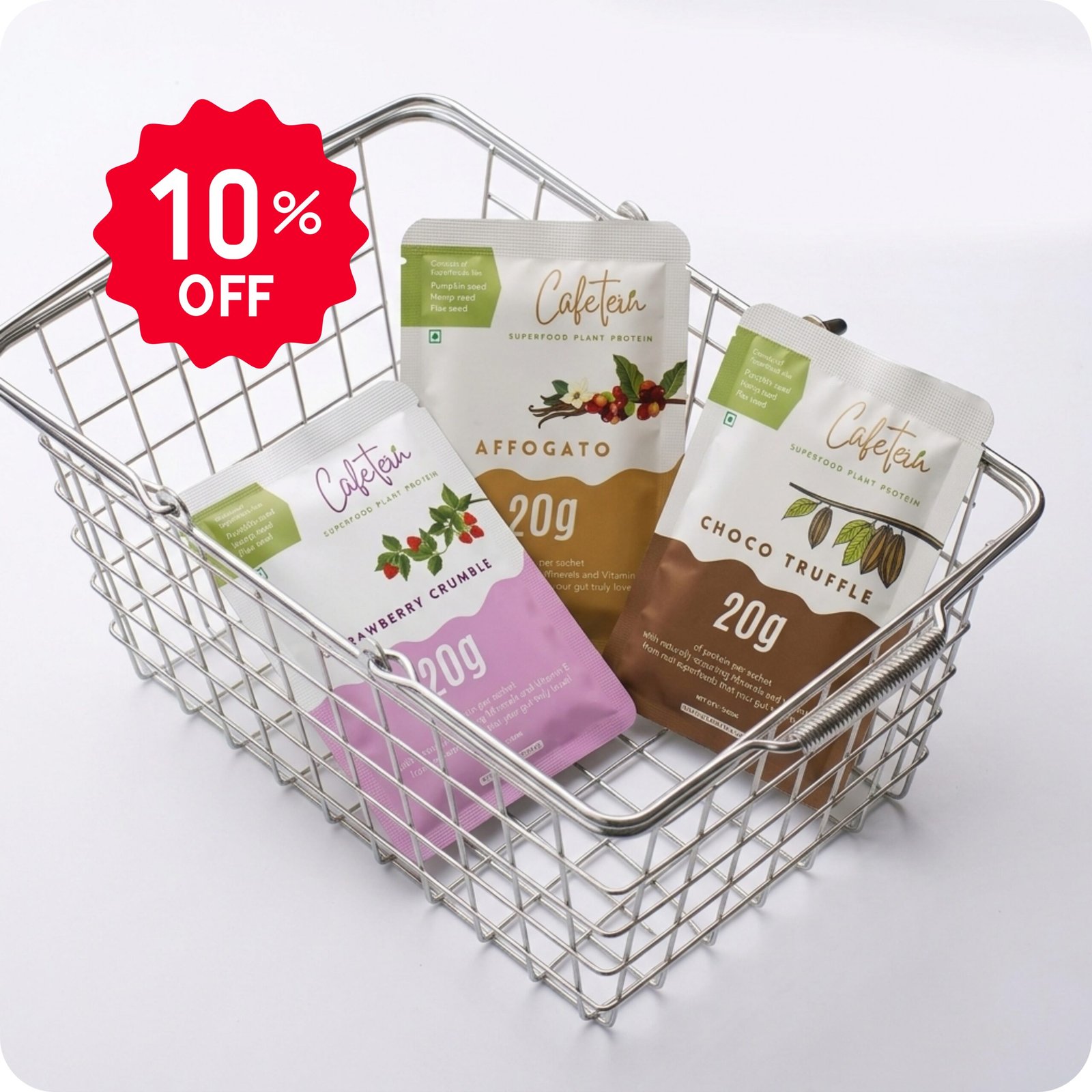
Why Cafetein Uses Multiple Plant Protein Sources
This is one of the reasons we didn’t want Cafetein to rely on just one plant protein.
Our formulation combines:
Pea Protein Isolate
Brown Rice Protein Isolate
along with protein-containing seed ingredients such as:
Pumpkin Seed
Hemp Seed
Flax Seed
The idea isn’t to throw a bunch of ingredients into a packet and call it “complete.”
Each ingredient has a reason to be there.
Combining different plant protein sources allows us to create a broader nutritional profile while also contributing to the overall protein content of the product.
And that’s the bigger lesson:
Don’t judge a protein powder only by whether the word “plant” or “whey” appears on the front. Look at the actual protein sources and formulation.
Do You Need Protein Powder to Get Complete Protein?
No.
Protein powder is a convenience food.
You can obtain essential amino acids from regular foods.
For example, a varied diet can include protein from:
- Dal
- Beans
- Chickpeas
- Soy
- Peanuts
- Seeds
- Dairy
- Eggs
- Fish
- Meat
- Whole grains
The role of a protein powder is mainly to make it easier to consume a convenient amount of protein.
It isn’t a requirement for good nutrition.
The Bigger Problem: Focusing on One Meal Instead of the Whole Diet
Here’s where many people overcomplicate nutrition.
Someone eats a plant-based meal and immediately starts worrying:
“Did I get all my amino acids?”
Meanwhile, their total daily protein intake might be nowhere near what they need.
That’s backwards.
Before worrying about tiny differences in amino-acid ratios, get the fundamentals right:
1. Eat enough total protein.
2. Eat a variety of protein sources.
3. Include protein-rich foods regularly throughout the day.
4. If you’re training, make sure your overall diet supports your training.
5. Choose a protein powder based on its actual formulation rather than marketing claims.
The basics usually matter more than the internet makes them seem.
Final Takeaway
So, is plant protein a complete protein?
There isn’t one universal answer for every plant protein.
Different plants have different amino-acid profiles.
Some individual plant proteins may be limited in certain essential amino acids compared with others. But that doesn’t mean plant protein is “bad,” and it certainly doesn’t mean people eating plant-based diets cannot build or maintain muscle.
Pea protein and rice protein are a good example of complementary plant proteins with different amino-acid characteristics.
And when evaluating a protein powder, don’t stop at:
“How many grams of protein are in one scoop?”
Look deeper.
What protein sources are being used?
What’s the serving size?
What’s the essential amino-acid profile?
How is the protein processed?
What else has been added?
Because ultimately, the quality of a protein powder comes from the formulation—not just the word “protein” printed on the front.
Frequently Asked Questions
Is plant protein a complete protein?
It depends on the specific plant protein. Different plant proteins have different essential amino-acid profiles. Some may have relatively lower amounts of particular essential amino acids, while combining complementary plant proteins can provide a more balanced overall amino-acid profile.
Which plant protein is considered complete?
There isn’t one universal “best” plant protein. Soy protein is commonly described as a complete protein because it provides all nine essential amino acids in sufficient proportions. Other plant proteins have different amino-acid characteristics and should be evaluated individually.
Is pea protein complete?
Pea protein provides all nine essential amino acids, but its amino-acid pattern can be relatively lower in sulfur-containing amino acids such as methionine compared with some animal proteins. This is one reason pea protein is often combined with other plant proteins.
Is brown rice protein complete?
Brown rice protein provides essential amino acids but can be relatively limited in lysine. Combining rice protein with complementary proteins such as pea protein can help create a more balanced amino-acid profile.
Do you need to combine plant proteins at every meal?
No. You don’t need to perfectly combine complementary proteins at every meal. A varied diet over the course of the day can provide the essential amino acids your body needs.
Can plant protein build muscle?
Yes. Plant protein can contribute to muscle growth when total protein intake, essential amino-acid intake, resistance training, energy intake and recovery are adequate.
Is whey protein better than plant protein?
Neither category can be judged universally without considering the specific protein source, dose, amino-acid profile, digestibility, dietary preferences and individual requirements.
Why does Cafetein use pea and brown rice protein?
Cafetein combines pea protein isolate and brown rice protein isolate because these plant proteins have complementary amino-acid characteristics. The formulation also includes protein-containing seed ingredients such as pumpkin, hemp and flax.
How much protein do I need per day?
Protein requirements vary depending on factors such as body size, age, activity level and training goals. Rather than assuming everyone needs the same amount, your daily protein target should be based on your individual needs.
Is protein powder necessary?
No. Protein powder is a convenient way to increase protein intake, but it is not nutritionally mandatory. A well-planned diet can provide protein from a variety of whole foods.
Read Next
Plant Protein vs Whey Protein: Understand the differences between plant-based and dairy-based protein.
Monk Fruit Sweetener: The Truth About Monk Fruit & Erythritol: Learn what monk fruit extract actually is and why some products combine it with erythritol.